


Customers who are looking for custom engineered cables or custom wire cable assemblies are usually facing one of two challenges:
- A unique cable configuration that doesn’t exist off the shelf
- A production bottleneck that requires automation and precision
This case study shows how Southrock Engineering solved both for one customer.
The Challenge: Automating a “Simple” Two-Conductor Cable
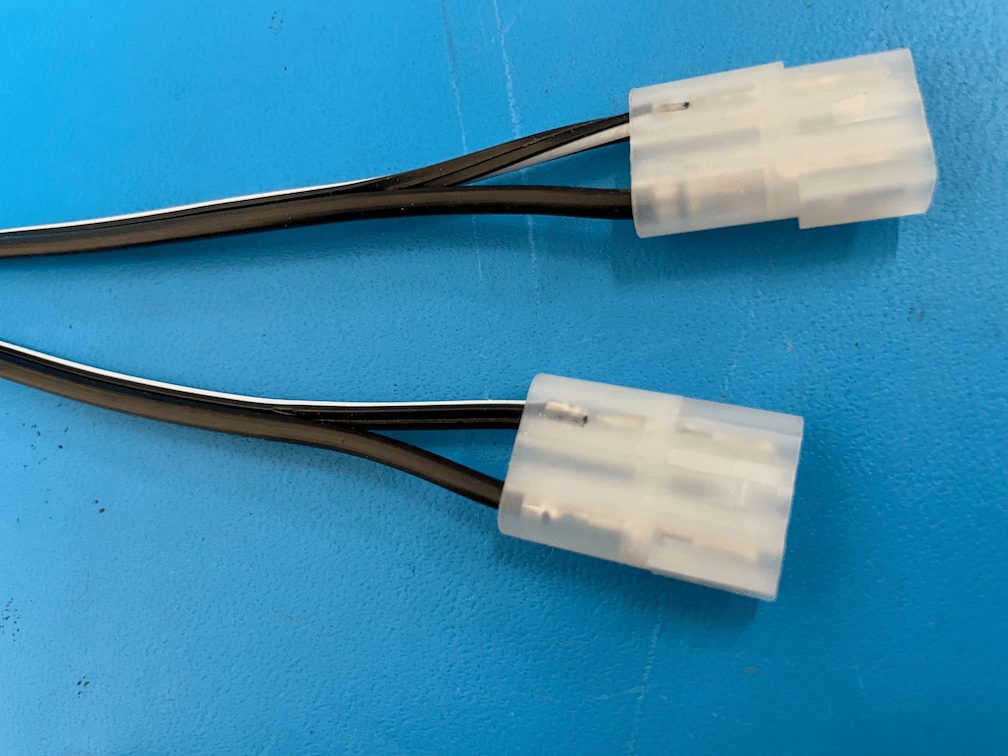
At first glance, the cable looked straightforward. It was a fused two-conductor wire (typically referred to as “lamp cord”) where both conductors sit side-by-side in a figure-eight shape. But the customer needed much more than a basic cut-and-strip job.
Each cable required:
- Precise cut-to-length processing
- Insulation stripped from both conductors
- Conductors separated cleanly
- Crimp contacts applied to each conductor
- A two-position connector on both ends
And it all had to be produced in high volume with consistent quality. This is where custom cable engineering makes the difference.
The Engineering Problem: One Cable, Multiple Precision Operations
Processing a single conductor is simple with modern automated equipment. Processing a fused two-conductor cable and separating it without damaging the copper strands… is not.
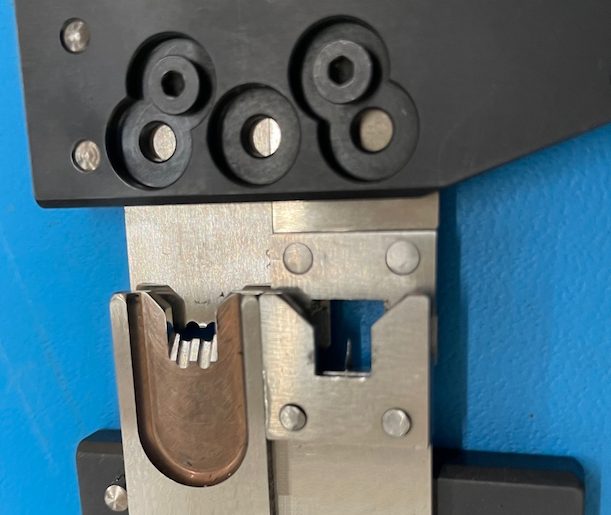
The process required:
- Dual-radius cut and strip blades
- A custom-designed slitting blade
- Precise programming of a multi-step automated sequence
- Exact control over dwell time, feed rate, blade depth, and clamping pressure
In other words, this wasn’t basic cable assembly. It was a fully customized cable processing solution.
The Custom Solution: Nine Automated Operations in Sequence
Southrock engineered a solution that performs nine automated operations in order, with indexing between blade systems to allow multiple functions on the same machine.
The Nine-Step Process
- Cut
- Strip insulation
- Measure length
- Cut
- Index blades
- Slit/separate conductors
- Index back
- Strip insulation (second stage)
- Eject and count
The machine performs these steps rapidly and consistently. You can see in the video that it’s way faster and more precise than manual labor.
Why Dwell Time and Blade Design Matter in Custom Cable Assembly
One of the most critical factors was dwell time. This is so the blades have a chance to cut through the insulation, rather than tearing the insulation off the bare conductor strands.
If the blade cuts too quickly or too shallow:
- Insulation tears instead of cutting cleanly
- Copper strands can fray
- Crimp quality suffers
If it cuts too deep:
- Conductors may be damaged
Southrock programmed precise blade depth and timing so insulation is cut cleanly without damaging the internal wire strands. You’ll also notice in the video that insulation remains on the very tip of the strands during ejection. This protects the copper from fraying before it reaches the crimping station. That level of detail is what separates customized cable assembly from basic wire processing.
From Processing to Crimp Termination
After processing, the wires move to an automated crimping station.
There:
- Metal contacts feed from a reel
- Connections are applied via a special punch and anvil set
- Each contact is precisely crimped onto the conductor
The remaining insulation tips are removed just before crimping to ensure perfect strand compression.
Proper strand control ensures:
- Strong mechanical connection
- Reliable electrical conductivity
- Faster production cycles
- Reduced failure rates
The Result: High-Volume Custom Cable Production With Precision
Because this solution is fully automated:
- Thousands of assemblies can be produced per day
- Output consistency exceeds manual assembly
- Labor time is dramatically reduced
- Equipment investment has paid for itself multiple times over
This is what customers are really looking for when they search for custom cable manufacturing — not just someone to assemble wires, but an engineering partner who can design an efficient production process.
Custom Engineered Cable Solutions for Complex Applications
Southrock Engineering works with your design…or helps optimize it…to create a scalable, production-ready solution.
This project highlights what Southrock does best:
- Reverse engineering existing cable assemblies
- Designing custom processing solutions
- Programming multi-operation automation
- Optimizing for cost efficiency and repeatability
- Delivering IPC610-compliant cable assemblies
Whether you need:
- Custom wire harness assemblies
- Prototype cable builds
- High-volume customized cable assemblies
- Specialized stripping or conductor separation
- Integrated crimp termination
Need a Custom Wire Cable Assembly?

If you’re struggling with:
- A cable design that can’t be automated
- Inconsistent crimp quality
- Excessive manual labor costs
- A unique fused or multicore configuration
Our engineering team can evaluate your application and design a solution that improves efficiency, quality, and scalability.
Contact Southrock Engineering to discuss your custom cable project.
We also offer PCB Design, Assembly and PCB Reverse Engineering !

Blog Contributions by:
Eric Crookston, Operations Manager at Southrock Engineering